Friday, September 14, 2007

A visit to Egypt and the Holy Land

April 26 - May 21, 2007
Misr Uma Dunia: Egypt is Mother of the World
Cairo or Al Qahira is Arabic for “the vanquisher” or “the exhausted.” In other words, it is such an exhausting experience for visitors that the name serves as a stern warning to any foolhardy visitor. Since my high school friend Chris has been teaching at an international high school since fall 2006, this was my excuse to go visit him.


Cairo has the heat of Phoenix, AZ and the traffic of Los Angeles. It is dirty, polluted and crowded with 16 million people. A city of incessant honking, Cairo’s traffic flows like a river. Its air quality makes Los Angeles air seem tame. When you return home after a day in the streets, your shirt collar will be black. (I arrived with a stuffy nose and a slight cold. It took me more than a week to recover.) I arrive on a Friday, the day of rest for Muslims in Egypt. My friend Chris advised me to look for the Fondooq (Hotel) Flamenco or “Fun duck” if I got lost. Fortunately, he greets me at the airport and quickly negotiates for a cab to take us to his apartment on the island of Zamalek, which is known as the foreigners‘ neighborhood.


The first thing the traveler learns about Cairo is the cab fare system: cabs do not use meters. One must never ask the cabbie how much the fare is; instead, you pay what you think the trip is worth and then walk away. Furthermore, you must first step out of the car, close the door and then pay through the window. It is a power dynamic. This way, you don’t argue with the driver. If he asks for more money, then you can give him one or two more pounds. If he persists, then you walk away. However, if he continues to protest, then the secret police is always around the corner. Any argument between a cabbie and a foreigner usually results in the foreigner winning.

Armwrestling with Egyptian kids
I take the subway to get a feel for the city. For such a dirty city, Cairo has a surprisingly clean subway system. I crowd into the train. While foreign visitors generally stay away from the subway system, I don’t attract too much attention. After a few stops, I decide to step off, but find myself wedged among the people. I realize that I must push my way out the train or I‘ll wind up at the end of the line. I finally get off at Dar El Salaam, which means House of Peace. I sit down on a bench. A few students pass me by and greet me with “hello.” I reply with "Asalam Alaykum" or Peace Upon You.


At the end of the platform, not far away from me is a group forming around two teenagers facing each other. Each of their friends tries to hold them back. They look like they are ready for a fight. While I can’t hear what they say, they most certainly could be saying, “want a piece of me?” The crowd moves along the platform, then up the stairs.

At this point, I cross over to the other side of the tracks to catch the train back to Nasser station, my starting point. I sit down on a seat and it seems school is letting out. Large groups of students pass me. One group greets me with some Arabic, some English. I utter the few Arabic words that I learned in my 10 week Arabic course in DC: “Ana Andy. Ana min Washington, DC fee Amreeka.” I am Andy. I am from DC in America.” After speaking with a few students, suddenly, about a dozen surround me and each one shoots off a question:

-Where are you from?
-Where you live?
-What do you do?
-Do you have moe-bile?

I respond as quickly as I can: “Made in China.” One student named Almosfra responds, “Made in Egypt” while placing his right hand on his heart. My Arabic is as good as their English, which is to say terrible.

I give out my business card to a student and write my phone number on the back along with email. Soon, every student in the group asks for my card and phone number.

Two police officers in white uniforms approach us to check on the commotion, perhaps to break up the group, afraid that they are harassing me. I say to them “Sadeek” or friend in Arabic and point to all of them. The police smile and quickly understand. They return to their posts.

After speaking -- or more accurately -- trying to make conversation with these kids, I shake hands. Lots of them. I say “tesharafna” repeatedly, or good to meet you. One of them suggests that I arm wrestle him. I do and they ask for a picture. Then a group picture. We move down the platform. One student extends his right arm akimbo and hooks my left arm and escorts me a few feet away.


Another student takes my bag, almost to hold it for safekeeping. When the train arrives, we board. They ask me where I need to go. “Nasser,” I respond.

Onboard the train, we continue in broken English and Arabic. Fellow passengers stare at us, amused that a Japanese tourist is carrying on with students. The students ask me about Jackie Chan. And ask if I know kung fu. Almosfra proposes that we arm wrestle again at Nasser. If he wins, then he keeps my watch. I agreed. I suggested that if I win, then I keep his army hat. It was a deal.

At Nasser station, we make the motions of warming up for a few minutes. I ask for two out of three tries. I win. So, as soon as I reach for his cap, Almosfra’s smile becomes a frown. He looks like he’s about to cry. I open my bag and pull out my brand new orange cap from the DC Chinatown Community Cultural Center. Chinese characters adorn the front and the English phrase “Washington, DC” is on the side. I hand him the hat and say “this is for you” as I take his army cap. His smile quickly returns.

We take a few more pictures. He asks me, “football? Bokra inshalla hina sa’at ithnan”
Tomorrow, God willing, 2pm, here. I agreed.

We shake hands and he gives me a traditional Middle Eastern greeting of a kiss on each cheek. “Don’t forget us,” he exclaimed as he boards the train. I wave goodbye.

I really wanted to return to the platform at 2pm the next day, but I wound up going to Khan Al Khalili market with Eleni, the Greek.

Sabri, the Khan Al Khalili vendor
Sabri is 24 years old, tall, and wears an orange shirt and jeans. His hair is shaved close to the skin. A fast talker with very fluent English, Sabri escorts us around after the glass purchase. Eleni tells Sabri she needs perfume, so Sabri takes us to a perfume shop that is slightly bigger than a broom closet. Eleni then tells Sabri that she wants to buy her father a shirt. So, Sabri takes us to another corner of the market. He spends nearly two hours with us.


After his parents divorced, his dad told him, “Sabri, come to the US where it’s free--you have cars, house, swimming pool.” However, he chose to stay with his mother in Cairo.

He’s been at the glass shop for a few years now. When he needs to step away for errands, his “boys” or friends keep an eye on it. His girlfriend was Italian, but “I hate Italy and Greece” even though he’s never visited. “I’ve done sex twice only with my Italian girlfriend,” he confides in me.

I ask Sabri about prayers and if he can recommend a mosque to me. He tells me to call him on Friday morning and he will take me to a mosque.

A visit to the Mosque
I meet him after noon and we talk a little. Before we walk over to the mosque, he takes me to a little corner where a small, unofficial prayer area was set up—a washing station with a plastic green floor.

I set my bag down and follow his move: he washes his hands using tap water. I copy him. He washes his arms, face and behind the ears and neck. I remove my glasses and do the same. We then walk to the prayer area, remove our shoes and he chants some prayers. He prostrates himself. I do the same. After a few minutes, he tells me the correct way to pray. When prostrate, the nose and forehead are touching the floor or rug. The hands are flat, but not the entire forearm. On the wall hangs a large poster explaining the correct and incorrect prayer positions. It looks like a golf manual: feet apart, but not too far apart and not too close together.
-Hands on the knees with fingers spread. Sabri rubs some perfume on his hands and face.
-Left hand on the chest, right hand covering left hand, but not in a mummy position

After this “practice session,” we walk over to the mosque, a big edifice with several dozen men inside. An imam climbs to the top of the stairs of a big platform. He is dressed in a white skullcap and galabiyeh, the flowing robe of Egyptian men. We pray five times and sit for the service. I understand nothing except for “Mohammed” and “Allah,” which the imam used frequently in his fiery sermon. (As I write, there’s another call to prayer)


The Imam must be in his early 50s. He looks like a very devout and earnest man. He gesticulates with his arms: first, his right hand with fingers outstretched slices the air, conductor style. Then his left arm, with finger in the air. With eyes wide open, he screams and his voice dances. He could very well be a Southern Baptist preacher. Whatever he said, he was emphatic and animated. He punctuated a few sentences with “Allaaaah!” After 30-45 minutes or so, everyone stood up and prayed in unison. A cantor repeated a few prayer lines, sang and the audience responded with “Ehhhh-mean” or the equivalent of “Amen.” Finally, “Assalam Alaykoom” or “peace upon you” and we shook hands with our neighbors. We put our shoes on again and as we left, some men by the exit passed out round buns made of sweet bean paste. It reminded me of Chinese buns.

We return to the shop and for the next three hours, I just sit there with Sabri and enjoy tea and fateer bread (like crepes). Sabri has been working for eight years in the store. He served in the Egyptian Army for one year. He calls it the “black year” because whereas he was used to perfume and friendly, polite people, he was subjected to rude, coarse, uneducated Egyptian men. He trained in the desert and then learned a bit of computer programming. His uncle has opened a store in New York City for nine years now, but has not returned to Egypt. His other uncle has been in the US for nearly a year in DC.

Sabri had an Italian girlfriend for nearly two years. She studied in Egypt and was not religious. Sabri says he does not push his religion on anyone.

He introduces me to his friend Mohammed, but goes by Mido, a nickname for a famous soccer player. Mido is a virgin. Once, he met some Japanese girls at the market. They invited him to their hotel room for Champagne, but something came up at the last moment, so he had to cancel. He’s regretted it ever since. “That was my one chance!” he exclaimed with a big smile.

The tea man comes to collect my tea glass, even though I only drank half. Sabri complains to him and then chases after him. Sabri gives him a swift kick in the ass. He explains that the tea man has a bad habit of collecting the tea glasses before customers even finish.

His friends ask me to write their names in Chinese, so I spend the next hour or so doing this. It occurs to me that the Egyptians are quite fond of Chinese people and their writing.

Sabri invites me for a game of soccer the same evening. I tell him I am no good. “Don’t worry. Neither are we.” He and his buddies meet once a week to play a game. Sabri tells me to return about 9:30pm. “Bring a camera, wear good shoes and a white T-shirt,” he advises me.

I return about 9:40pm. I am afraid that they may have left without me. However, when I get to the shop, they are still there. They begin to close the shop and warm up for the game. I meet Zayman, Sabri’s friend who has an Ipod and is swaying to some Hip Hop music. They ask me how many pushups I can do. They then take out some Hashish joints and offer them to me. I politely refuse. They explain that it is custom to smoke before a soccer game. It is the Egyptian way.

I am tempted, but think of a future confirmation hearing when a senator may be asking me about my previous drug use. Would I respond by saying, well, “I’ve never knowingly broken the laws of my country. And that one time, well, I didn’t inhale.” Better safe than sorry. They pass the joint around and then blow some smoke into my face. Cough. Cough. Cough. Laughter. We leave for the soccer field about 10:30pm.

We walk through the narrow alleyways of the market. All the tourists have gone. Vendors are cleaning up. Eating a late dinner. Mido offers his right arm and I loop my left arm in his. He tells me that “even though I’ve only known you for a few hours, I feel like I’ve known you a long time.” We turn and twist through the walkways. I catch a glimpse of some men and women dancing on a rug to the tune of music. Sufi mystics, perhaps? Mido explains to me that after hours, the market is very different. These vendors are more relaxed and feel like they can dance in the comfort of their shops.

We reach the soccer fields and divide up the group. I play for about 15 minutes, then Sabri sends me to the sidelines, where I stay for the rest of the game. We win 7-2.

After the game, the winners drink Coke, Pepsi and Sprite. The losers drink water. It is now about midnight. Sabri asks me, “It is late. Maybe you want to return to your friends and rest? If you want, you can come to our neighborhood and drink with us.” By drinking, Sabri meant chocolate, yoghurt, more Sprite and Coke.

At a local café, we enjoy hookah and watch American music pop videos with Jayzee, Beyonce’ and Shakira. No women are in the Café, which are still the domain of men. It is now about 1:30am and Sabri and Mido hail a cab for me. They pay for my cab fare in advance. I thank them and bid them “Maesalama!” or Good-bye.

The driver, like most Egyptian cab drivers, is extremely friendly, but has very limited English. He tells me that he’s visited the US before. He was part of a tour group that went to New York, New Jersey, Washington, DC and Tennessee. He then turns toward me and raises his right thumb while saying “Bush. Yeah!” He has a big smile. I am shocked and do not know whether he is serious. I reciprocate, raise my right thumb and say, “Hosni. Hosni Mubarak. Yeah!”

When we arrive at my apartment, I pay the cab fare again. The driver is silent. I bid him a good night.

A visit to El Alsson International High School
Chris and I catch the 7:05 am school bus, which is a 30 minute ride to the International High School. The students come from rich Egyptian families who can afford the annual 30,000 Egyptian Pounds (LE) tuition. To give you an idea of how much this is, the average Egyptian family makes about 300 LE a month.

I sit next to Hanan, a quiet little girl, who later asks Chris about me: “Is he married? Is he teaching at the school? He‘s so nice.”

In class, I give a short presentation on the 2008 Presidential race. I begin with a short anecdote about Mitt Romney‘s leadership. I discuss the importance of fundraising and ask the students for some ways of raising money. One student recommends “steal money.” I ask him, “so, you’re entering politics, yes?”


On the way home from school, the kids on the bus pepper me with questions:

-Have you ever eaten Monkey?
-Do you know Kung Fu?
-Why do they kill babies in China?
One girl asks me, “In China, parents make their kids stay up on New Year’s eve for good luck, right? According to the book of traditions.” I tell her that this is news to me.

Yehia, a precocious nine year old Egyptian boy with a big smile tells me, “in Australia, if you use counterfeit money, you go to jail.” Born in the US, he came to Egypt when he was four years old. He proudly explained, “We have three villas in the US. Whenever I visit America , I stay in one of two villas or the Ritz-Carlton Hotel.”

The kids want me to write their names in Chinese, so I spend the rest of the bus ride writing as many names as possible. I promise to return next week to finish writing names.

The Great Pyramids of Giza
The climb inside the Great Pyramid has been described as claustrophobic. As I climb, I grip both wooden handrails. Wooden slats about a foot apart on top of the stones help visitors to climb. I can only imagine in ancient times that the pyramid builders would enter with slaves in front carrying a torch and slaves behind them with a torch, while they used ropes to climb. After about 10 minutes of climbing, at the very top, I bend down and squat to cross a 15-20 foot space to enter the chamber. It is dark and musty. Two phosphorescent lights hang on the wall. A few tourists are inside, but they are impatient and leave quickly. An empty sarcophagus lies at the end of the room. I don’t know when I will return, if ever, so I stay a while and try to absorb everything around me, to rest and enjoy the quiet.


A few moments later, a group of four Frenchies arrive. The man – in his late 40s, climbs into the sarcophagus for a few minutes to rest. Once he gets out, the others follow. The woman, standing against the wall, stretches out her arms like she is at a church service, ready to receive the holy spirit. The gentleman begins to sing a French song. He has a very beautiful voice that sounds quite professional. His voice reverberates around the room, which, surprisingly has good acoustics.

Reny, backstreet boy of the Pyramids
We begin to make our way to the Sun Boat Museum, dedicated to the boat that would take the dead to the underworld. Soon, a young boy begins shadowing us about 20 feet away.
“Hello! Where are you from?” he greets us in a loud and friendly voice.
“Alaska,” I reply, trying to alternate my answers. I was tired of telling people I am from CA.
He introduces himself as Reny, a student. “I will enter the faculty soon,” he adds enigmatically.
He wears a black T-shirt and jeans. His skin is dark chocolate.
He carries with him a spiral notebook and pen. From a small town three hours away, he rode three buses to get to the pyramids.
“I am also a singer, dancer and painter, but my parents don’t know.” He lists the songs he liked and offers to sing a backstreet boys song.

When we arrive at the Sun Boat Museum, I take out my cash, wanting to give him a one pound tip for singing us his backstreet boys song. He refuses.
“If you love me, you won’t give money to me,” He objects.
I try a second, and a third time. He refuses. I put my money away.
Chris and I buy our tickets and thought that Reny would leave.
Instead, he follows us. “Please wait me!” he pleads, as he goes to the counter and pays his two pound ticket. We pay 40 pounds each.


Inside, Chris, a bit annoyed, walks ahead of us. Reny tells me that if the police see him talking to me, they will “beat me and take my credit card.” He pleads with me not to turn him into the police, “Please don’t give up me.” I promise him I would not.

He opens his notebook and shows me all the email addresses he’s collected from tourists in the past months. The other pages of the book are reserved for verbs and vocabulary.

As we walk around the great boat, Reny points to the photos on the wall and tries to explain a few of them. I point out some misspellings in the captions.
Reny asks me, “Where’s your friend?”
“He’s in the bathroom,” I reply. “Where are your friends?” I inquire.
“I haven’t any friends,” he explains. “I am very happy to meet you today.”
Reny usually comes to the Pyramids once a year, but this year he’s visited 10 times.

Outside, as we walk, camel drivers accost us for rides in the desert. I tell them that I want to eat camel, not ride them.

Reny sings us some more songs, including one in Arabic. He has a decent voice.
A tourism police officer on a camel approaches us and yells at him not to bother me. I respond that he’s a “sadeek” or friend.


We approach the exit road and at this point, I take out five pounds and offer it to him. He refuses three times. I insist. He says, “the police will see you.”
So, I turn my back to the police and give it to him. He reluctantly accepts it.
He still follows us as we walk down the road.
I take out my water bottle and offer it to him. He refuses. I insist and he finally takes a few sips.
I am amazed by how tough he is—to be able to talk so much, sing several songs, yet not carry any water. I tell Reny to keep the bottle of water.

Reny asks me, “do you go to zoo?”
I have not. He asks me if I want to accompany him to the zoo tomorrow. I ask him to email me. I learn later that at the Egyptian Zoo, one can pet the animals.

We shake hands and get into our cab to go back home. I checked my email later, but Reny never contacts me.

Cairo vs. Luxor
Luxor and Cairo are cities where the fruit at kiosks are presented in a beautiful way. They hang their bananas one bunch above the next on one pole or line—almost like it’s growing naturally on a tree.


It is a common occurrence that I am greeted with English ie “Hello. Where are you from?” I try to respond in basic Arabic.

The minibuses and vans that circle the city for locals never close their doors. Perhaps, they are kept open to cool the car and to facilitate the boarding and exiting of the bus?

Men shout. Boys shout. Women shout. Old Women shout. Everybody shouts. They shout to greet each other. Men in galabiyehs shout to their friends. It may sound like they’re fighting, but they’re not. They are just having a friendly chat.

Bus trip to Gebel Mousa or Mt. Sinai
My original plan was to fly to Israel; however, my friend Monica, who visited Egypt 25 years ago, advised me to take the bus. I would see more of the country, she explained. Besides, it would be much more interesting. Heeding her advice, I bought a bus ticket to Mt. Sinai, on my way to the Israeli border.

The six hour bus trip would become a nine hour bus trip. Along the way, our bus driver stops a few times for ½ an hour each to smoke some hookah (water pipe). A couple of times, we stop in random parking lots just to rest for 10 minutes or so. We pick up Bedouins. Lots of them. We cross through a series of checkpoints, about five total. Each time, a stern-looking man--sometimes in uniform, sometimes not--boards the bus to examine our IDs.

Arrival in St. Katherine City
It is 7:45pm when we pull into a traffic circle in St. Katherine City. The last rays of sunshine disappear. A few others and I get off. Two men pull up in a white van. They want to take me to a Bedouin camp. I thank them, but refuse.

I see two men in running gear jogging toward me. They speak a little English and direct me to the restaurant area. They reassure me that this is a very safe area. I walk for a few minutes. Suddenly, the white van pulls up again. The same two men offer me a piece of cookie and want to take me to a Bedouin camp. I take their cookie and swallow it quickly. It’s very sweet. Their camp is just across the way. After a few minutes of talking, I get into the van and they whisk me off to their desert oasis.

At the Foxcamp Bedouin Camp or Youth Hostel, I meet Hillary, an English woman in her early 40s. She’s been in the Sinai 2.5 years, working with Bedouins. Ali, another British guest is about 24. He sports a buzz haircut and is dressed in a galabiyeh, the Egyptian robe. He’s been traveling for 6 months following the trail of Alexander the Great. Ali has been studying Arabic for four years at Exeter University. Of 35 students who began the Arabic class with him, only he and one other student are still pursuing the language.


A small group of Bedouin well-diggers are also staying at the camp. I try to talk with them with Ali serving as the interpreter. They travel the Sinai helping people to dig wells or deepen existing wells. Their group leader is an amiable man with calloused, but warm hands. He speaks only a few English words. I offer him my help in their efforts. “I am not very strong and only have a few hours to help you tomorrow. I may work like a woman, but please tell me how I can help,” I explain to him. He responds that I can simply bring him water in the morning.


Climbing Mt. Sinai: following camels in the dark
Mt. Sinai is known as Gebel Mousa in Arabic or Moses Mountain. After dinner and chatting with Abdul, the cook, I leave the camp about 2 am and begin walking toward the mountain. It is dark. As I walk along the road, buses pass by. I reach the security check point where hundreds of pilgrims are ready to ascend the holy mountain.
Mr. Security: “No bomb, ey?”
I reply, “I love Egypt and Egyptians, so no bomb.”
As I continue along, I see and hear Koreans, Egyptians, and languages from all over the world. A flurry of flashlights and torches lights up the ground.
I hear an Italian group and strike up a conversation. They are from Venice. Maria tells me that she, her sister and friends are here with a tour group. She has studied Arabic and wants to visit more Arabic countries.


Bedouins are lined up at key parts of the trail by the coffee and tea stations and accost the pilgrims. “Camel? Want a camel? Camelo? Ciao!” The prices for camel rides decrease proportionally the higher you ascend.

Maria responds, “La-shookrun,” or no, thank you.
I walk with Maria and her sister until 5:30am when we approach the summit. I take a rest and meet a Chinese Indonesian family. Daylight arrives about 5:40am. The view is panoramic and breathtaking.


One group of Philipino Catholics gathers in a circle, hold hands and pray and sing.
Most other pilgrims snap away with their digital cameras.

It is wonderful to see so many people from all over the world gather in one place that links them all.

The next day, I miss my bus, so after one more day, I catch the bus to NuWeiba. When I get off, I see no connecting buses. A cab driver offers to take me to the border for 100 LE (about $20). I bargain him down to 90 LE. He speaks no English except for numbers.

We pick up two men. The first one asks me about my religion. I try to explain that I am “mish deanee” or not religious. He doesn’t understand. He asks me, “do you have gift for me?” as he smiles. I give him my business card.


The driver asks me if I am a Muslim. I reply no, but I “bihab Muslim wa Mohammed wa Allah.” I like Muslims and Mohammed and Allah.” He needed no further prompting. He turns off the regular music and puts in a cassette tape of Koranic chants for the next hour as we approach the border. Once we arrive, he asks me for a $3 tip. I refuse, saying, “you’ve done nothing to earn the tip.” Instead, I give him a US flag pin. He accepts it and in turn gives me his business card, asking me to call him again when I return the following week.

Interrogation at Taba Border crossing on Shabbat
Israeli security layer #1:
“Hello. Why are you coming to Israel?”
Vacation.
“Who do you know?”
No one.
“Where have you been?”
Cairo, Egypt
“Where do you work?”
At a PR firm.

Israeli security layer #2: x-ray machines
Israeli security layer #3: Two female border agents question me. The first one is in her late 20s, blonde and pale. She has a very serious demeanor. A silver star rests on her left breast. The second one, a brunette, wears heavy mascara, but has a slight smile.
“Who do you know in Jerusalem?” the blonde begins her questioning.
No one, but I have a few contacts.
“Can I see your contacts?”
I flip open my notebook to show them my contacts and phone numbers. They are in the same notebook that I use for my Arabic class.
“So you are studying Arabic? Why?”

“Do you have an itinerary? Can we see it?”
I show them my e-ticket printout.
“Where have you been?”
Alexandria, Luxor, Sinai.
“Where are you staying in Israel?
I show her the two youth hostels that I found on the internet.

“Why do you travel alone? Why don’t you travel with a friend?”
I’m very independent and it’s hard to coordinate with a friend who can take off this much time.
“How much money do you have with you?”
1600 Shekels. (about $400)
“Can we see your shekels?”
I place the money on the counter.
“That’s a LOT of shekels for one week,” she commented, with a hint of suspicion in her voice.

At this point, the group behind me urged the border agents to hurry up as sunset was approaching, marking the beginning of Shabbat or the Sabbath, the holy day for Jews. The border agent did not seem to be concerned at all.

“Do you have any other payment besides cash?”
Yes, a credit card. I show her my Chase visa.

“Do you intend to visit any Palestinian-controlled areas like Gaza?”
No.
“Why not?”
I don’t want to die.
They release me and I enter Israel.

Eilat, Israel
Eilat is the most famous resort city in Southern Israel. After two weeks in Egypt, where most of the women are covered, it is quite a pleasant shock to the system to see so many scantily clad women with their navels (and more) exposed. The cab driver deposits me at the Red Sea Hotel.

“Isn’t getting laid the best thing to do on trips abroad?” Yitzhak, the 67 year old manager of the Red Sea Hotel asks me with a broad smile. Originally from the Pittsburgh area, Yitzhak has lived in Israel for well over 40 years. An engineer by training, he tells his life story to me over a beer. He is a serial smoker: with a cigarette in his left hand, he is unshaven, balding, and very skinny. He coughs occasionally.

“My problem is chasing women. In two weeks, my girlfriend returns.”
“So, you’ll have two weeks of freedom?” I inquired.
“No, I’ve had three months of freedom,” he corrected me.
“Best thing to do is to date married women because they usually keep it quiet.” He advised me.
“You’re a hedonist!” I declared.
“I like alcohol, sex and basketball. My fantasy is to have a glass of whiskey in one hand, for her to blow me, and watching the MaCabees win by one point with a three point throw, so we’ve had lots of practice!” He said matter of factly. But, this happened only once.

On prostitution: once a week or so, “if a guy comes to me and asks for a whore, I call her and she comes and for 250 Shekels, he has a good time.” She tips the guy at the counter 50 shekels. At this point, he clarifies the legal definition of pandering.

The next day, I take the four hour Egged bus to Jerusalem.

The Old City
Jerusalem’s Old City is a place where you feel the large stones of the narrow alleyways with every step you take. It is a place where the vendors know your nationality before you open your mouth. Where as soon as you respond to the “hello—where you from?” you are one step closer to buying from them.

Where Israeli Military patrols come through hourly. Where school kids pass by with a guardian in front and a protector in the rear with a rifle strapped onto the shoulder. Where groups of Israeli soldiers, all with their side arms, lounge for tea or lunch next to tourists. It is a place both enchanting and overwhelming. Where everyone sells the others’ religious symbols. That is to say, Muslim vendors hawk Catholic prayer beads and crosses; Christian vendors hawk Torah scrolls and key chains. Jewish vendors hawk postcards of Dome of the Rock, where Mohammed ascended to heaven. Where Observant Jews touch the Mezuzah on the side of Jaffa Gate as they enter the Old City as a reminder of the role of the 10 Commandments in their lives. Where a trio of Orthodox Jewish men, with black hats and black coats walk by, speaking Hebrew or Yiddish. Where the Russian tourist strolls by, with her belly button winking at you.


Into the Judea Desert
I sign up for a day tour to Masada, the Dead Sea and Jericho. As we enter the Judea Desert outside Jerusalem, our Palestinian Christian tour guide explains that the old name was “Valley of the Shadows.” And for good reason. In Roman Times, our guide continued, “rubbers would kill you for your donkey.” He repeated himself. Now, of course, the area is much safer.

We stop for a few minutes and get out of the van. The guide points to a distant spot on the horizon. “That’s Nabit Mousa—the site where Muslims believe Moses died and was taken to heaven by angels.” Now, the site is used for a drug addiction recovery center. It is ideal since it is very hard to find narcotics in the desert.

Juliana, a Brazilian gal forgot her passport. Our guide advises her to speak only Portuguese and the security guards will leave her alone.

A Visit to Masada Fortress
We take the cable car to the top. A hardy group of five and I decide to walk down the mountain. The panoramic view is spectacular.


About 70 CE, the Jewish people, fed up with occupation, rise up against the Romans, who in turn, send in the troops to crush the rebellion. Their slaughter of the inhabitants of Jerusalem and surrounding areas was thorough, as chronicled by the famous Jewish-Roman Historian Josephus Flavius: “They piled mounds of corpses in the street and drenched the city with so much blood that in many places blood extinguished the flames.”

It took the Romans a few years to crush the rebellion. Toward the end, Josephus wrote, “And no one shed a tear at the tragedy and no one eulogized the dead, because hunger had subdued all of their human emotions.” After the city was conquered, there was one place that still held out against the Romans: Masada, or “Fortress” in Hebrew. It had become a focal point for rebels in the desert and the die-hards fighting the Romans.


Here’s the basic story, according to the Let’s Go Israel 2003 guide book:

Masada became a refuge for surviving Zealots…With years’ worth supply of food, water, and military supplies, the 967 men, women, and children held off 15,000 Roman legionnaires through a five-month siege. The Romans called in their best engineers to construct a wall and camps in a ring around the mount…they built an enormous stone and gravel ramp up the side of the cliff, using Jewish slaves as laborers in order to prevent the Zealots from shooting them.

When the defenders realized that the Romans would break through their walls the next morning, the community leaders decided that it would be better to die. Their leader Eleazar said, “unenslaved by enemies, and leave this world as free men in company with wives and children” rather than be captured by the Romans. Because Jewish law forbids suicide, ten men were chosen to slay the others, and one chosen to kill the other nine before falling on his own sword…The following morning, when the triumphant Romans burst in, they encountered only smoking ruins and deathly silence. The only survivors, two women and five children, told the story of the Zealots’ last days to Josephus.

Understandably, new recruits to the Israeli Defense Forces are sworn in at Masada with this pledge, “Masada shall not fall again!”

Dead Sea
We visit the Dead Sea at Ein Gedi for one hour. It is the only place along the Dead Sea that has no entry fee. Our tour guide explains that Queen Cleopatra used products from the Dead Sea for her cosmetic needs. She had to look good for Mark Antony, after all.


Before we enter the sea, we are advised not to stay in for more than 15 minutes at a time or we’ll turn into raisins. Every few minutes, I hear a loud scream after some hapless floater swallows some salt water or it enters their nose or eyes. The future of the sea is not promising as it is slowly losing water each year. Our guide adds, “We don’t want to lose the Dead Sea as it’s very important to us.”

Bethlehem
As the birthplace of Jesus, Bethlehem means "House of Meat" in Arabic or "House of bread" in Hebrew. Either way, it means food. I walk from the military checkpoint to the Church of Nativity, and got lost in the marketplace. At one point, I ask five Palestinian Policemen with very big guns for directions. After I utter the magic words "Asalam Alaykum" smiles appear on their faces and they gladly help me.


The Arabs are so much more colorful in their greetings than we are.
I offer them the morning greeting: “Sabah Al kheir.”
The policeman responds, “Sabah Al Nur” or “A morning of light to you.”
I respond, “Sabah al full” or “A morning of flowers to you.”
He responds, “Sabah al ishta“ or “A morning of cream to you.”
I finish with “Sabah al yasmin“ or “A morning of jasmine to you.”

Shabbat dinner with the Rabbi
At my youth hostel, I meet David, a Catholic pilgrim from Austin, TX who is on his seventh trip to the Holy Land. He is a Mexican-American in his early 40s and currently lives in Utah. Married with three children, he is a firm believer and likes to come for three weeks annually to “reconnect and to renew” his faith and spirituality. David invites me to a Sabbath Dinner or “kid-dooosh.” He pronounces the Hebrew word “kiddush” (the breaking of the Chala bread and drinking of the Kaddim wine after prayers) with a strong southern twang. We first go to the Church of the Holy Sepulchre, the most sacred site in Christendom. It is said that Jesus was buried here and rose three days later.


David serves as my tour guide; he shows me the marble slab that Jesus lay on after the crucifixion. He kneels and kisses it. Next, we view the rock that Jesus sat on when he was crowned with thorns; the hole in which his cross rested in; the tomb of Constantine’s mother; the rock which cracked after the earthquake following the crucifixion.


We walk over to the Western Wall. It is a warm afternoon sun. Pilgrims fill the plaza. We meet Rabbi Mordechai and a few others who are finishing up their prayers. The Rabbi is from Chicago and has lived in Jerusalem with his family for more than 20 years. A jolly man, perhaps in his 50s, he wears a long white beard and a solemn black outfit, in the tradition of Orthodox Rabbis. The group begins the Kiddush and shares with us grape juice, cookies and nuts. They sing some songs. One gentleman in particular is a robust cantor. He seems to be the unofficial cheerleader of the group. After 15 minutes or so, the Rabbi announces to his minions that “I’m having a Shabbat meal at my house. Anyone is welcome to join me.” We follow our host and start walking toward Damascus Gate.


After nearly 30 minutes of a brisk walk, we arrive at his home in a quiet suburb. It is about 2pm. I count at least 40 people waiting for him in his dining room. Everyone is seated at narrow, thin tables. Somehow, we manage to make room for another 10 guests. Every 10 minutes or so, another few guests would arrive at the door. The Rabbi does not turn them away. Instead, he cheerfully welcomes them and says, “Come on in! We’ll just set another table. We have plenty of room.” In total, perhaps 70 people or more crowded into the dining room, which was designed for only 20 or 25 people at the most.

The Rabbi is a generous host. His waiters – most likely his family – prepared lots of food, which float on trays above our heads. Chicken. Roast Beef. Tuna. Salad. Fruit. Pie. The generous servings are punctuated with abundant singing, prayers and announcements. If there were room, I’m confident the attendees would dance. By about 4:30pm, the Rabbi announces that some people have to leave, so he requests that we “be respectful of others and leave quietly.” However, dinner would begin at 7pm, so he encourages us to return at that time, or stay as we begin reading the entire book of Psalms. David and I look at each other and take this as our hint to leave. We thank the Rabbi for his hospitality and depart.

Final day in the Holy Land and return to Cairo
Sunday morning 6am. I catch mass at the Church of the Holy Sepulchre with David. I then sprint to the Western Wall to pray and to leave my message for God: “Give me the strength to believe.” I search for a crack in which to leave my message.


Since the wall fills quickly with messages from pilgrims and worshippers, they are cleaned out weekly and buried. The idea is from the earth we come, back to it we return. Since the name of God is on those messages, it cannot be destroyed. It is now 7:30am. I walk up the ramp to the Temple Mount. I am greeted by five security men with very big guns. I greet the groundskeeper. “Asalam Alaykum!” His face lights up with a smile.


I make my way up the stairs past the arches, circle the mosque and the Dome of the Rock. Muslims believe this is where Mohammed ascended to Heaven in 621 AD for a night journey. Built in the 7th century by the 9th Caliph, it is visible for miles.

Border crossing at Taba
Ana* (I never got her name, so I’ve given her this name for this travelogue), a Jewish woman living in Australia is on travel by herself. In her mid to late 40s, she has dark shoulder length hair and pale skin. She has been waiting for six hours at the border crossing. Her travel agent told her the bus would arrive about 1pm, so she’s been here since noon without any food. During her six hours here, she received special treatment from very lonely, bored and horny Egyptian border agents who rarely ever come this close to foreign women. They asked her questions like, “So, what is your favorite position in bed? Do you like to be on top?” Those were the tame questions.

While we wait for our passports to be stamped, Mike, a New York lawyer currently teaching law in Jerusalem, tells me that our tour guide Moustaffa Mohammed wants him to bring over a can of coffee and $1500 in cash to the Egyptian side. Mike feels very uncomfortable about the request, so refuses.

After an hour of processing our passports, we finally make it to the Egyptian side and prepare to depart for Cairo. However, Moustaffa motions for Ana to come over to him. Could it be visa problems? She disappears for 20 more minutes. When she returns, she carries with her two big plastic bags of cigarette cartons. Our dear tour guide forgot to buy them earlier, so asked her to go back through the border to purchase them at the duty-free shop. The rest of the group sighs.

We arrive in Cairo about 1:30am. My ticket agent told me to expect an 11pm or midnight arrival, so I was not too disappointed. However, she informed the rest of the group that they would arrive about 7 or 8pm. So, naturally, they are livid. Shortly before we arrive at the Sheraton Hotel, Moustaffa pulls out an envelope and explains, “Can you kindly give a baksheesh (tip) of 10 LE each? This is the custom of Egypt. Thank you.” When the envelope returns to him, he receives only about 20 LE.

Outside the bus, he asks me to intervene. “You seem to have a good rapport with the group. Can you please tell them to give a tip? That’s the way we do things in Egypt.”
I explain to him the group is angry. Very angry. Especially at him. At this point, the group disperses. Most hail cabs to their hotels for the night.

When the driver hands me my bag, I give him a 10 LE bill, knowing that it is not his fault that we are late. I return to the apartment on Zamalek, pack my bags and depart for the airport.

The writer Nawal El Saadawi says of Cairo in her autobiography Walking Through Fire, “The moment that I arrive there from a journey abroad, I want to leave again. The moment that I am ready to depart, have climbed into the plane, I feel like jumping out and running back.” Now that I’ve spent some time there, I truly understand this odd sentiment. And I hope one day you will, too. Insha’ allah!

Sunday, November 26, 2006

On The Lam


Last night while I’m watching TV, I hear a helicopter pass over my house. It’s very loud and close. A minute later, it returns and sounds like it’s directly over my roof. I look through the window and see lights overhead. Either it’s a local TV news crew or the United Nations has deployed their black helicopters to begin their world government tonight.

I step onto my back porch and look up. I see a helicopter circling around with a searchlight. I have a bad feeling about this. The last time I was in this situation was when I lived in Sacramento, CA six years ago. At that time, three police officers were in my front yard, crouching with guns drawn. They were searching for an escaped convict.

I reach for my cell phone and call 911. The operator asks me, “Is this an emergency?”
“Not really…I see a helicopter overhead with a searchlight. What does that mean?” I respond.

“There was a robbery at 3500 Fairfax Ave. tonight, so we’re searching for the suspects.”

Fairfax is 2 blocks over from my house.

“I suppose I should stay inside and keep my doors locked, right?” I inquire.

“Yes, that would be a good idea.” She confirms. With that, I call my neighbor Patricio and point out the helicopter to him as well. I look up the location of the robbery and find that it’s just down the street.

Monday, October 30, 2006

Down and Out in Dupont


10/20/2006

On Friday night, my friend Sophal is visiting DC from New York. After we meet for a few hours, his friend offers to drive me home. We walk to Dupont Circle, where he is parked. I wait for him while he is using the bathroom. It is a cold and windy night.

A homeless black man with a slice of pizza drooping in his right hand approaches me.

He asks me, “Can I ask you a question?”

I reply sarcastically, “You just did.”

“Can I ask you another question?” he continues.

“Yes,” I say. With the pizza in his hand, I am fairly certain that he will not ask me for food.

“I’m trying to get an ID. It’s $20 at the DMV. I only have $6 in my pocket, so if you can spare a dollar, that would be very much appreciated.” He gives me the exact address of the DMV.

In his 40s, Kevin is disheveled and wears a big mustache reaching around the corners of his mouth. He has on a blue jacket, dark pants and black shoes. He is exceedingly polite.

“One time, I was on the street begging and a group of men passed by. One said, ‘Fuck you nigger!’ I thought that was uncalled for.”

Kevin describes his life since finding sobriety: “I have been sober since October 22, 2002. I’m trying to clean up my life.” He tells us that he works part time at the DC Convention Center for $10.69 an hour, but “it’s not enough, so I’m still on the streets.” He still attends his AA (Alcoholics Anonymous) meetings.

“Change if you must, die if you will!” he says authoritatively.

I ask him if he has family in DC.

“My brother was shot. My mother died of cancer. My father passed. That leaves just me.” He quickly explains. Kevin grew up in Northeast DC, which is considered the ghetto above H street.

“Where are you staying tonight?” I inquire.

“Out here on the streets,” he replies.

“It’s cold. Isn’t there a shelter?” I probe further.

“The CCNV is close by, but it’s past the hour at which I can get in, so…” he explains.

“It’s also dangerous because they can steal your shit, right?” I add.

“Yeah – I got my blanket and bag stolen there. So, everything I own is on my back.” He tells us.

Kevin sometimes attends the First Praise Church in Forestville, MD if he can catch the church van that picks up the homeless at the nearby shelter. He gives me enough details about the church service to make me believe him. He quotes a passage from “The Good Book.”

“Change if you must, die if you will!” he repeats.

“Once, a man wanted to take me inside to buy me a hamburger, but I hadn’t showered in a long time. I was ashamed to go inside,” he recounts.

Kevin impresses me with his clear mind and very detailed references. I find him to be persuasive and sympathetic. My friend agrees that Kevin’s overall beggar presentation is very logical. I normally don’t give money to the homeless, but I was prepared to give him at least $5. In the end, with my friend giving him $5, I give him $1.

In the car on my way home, my friend tells me that he has worked in the same homeless shelter that Kevin referred to in our talk.

While Kevin may have missed the chance to find save haven in the shelter tonight, he can use his time productively to beg for a few more dollars. To most people, that’s a terrible situation to be in; however, to Kevin and many others like him, it’s just a part of life on the streets.

Friday, September 22, 2006

True Father Loves You: mixing and mingling with the Moonies


Sunday 9/10/2006

Moonies. To the uninitiated, the word sounds like a cookie or fattening dessert. Perhaps, both are attractive on the surface, but contain questionable ingredients that may warp your body or mind.

For some time now, I’ve wanted to visit the Moonie Church in Mount Pleasant. As a part of my ongoing spiritual exploration, I discovered the place when I lived briefly in the neighborhood in December 2005. They go by a few different names. They’re known as the Unification Church, but they’ve recently changed their name to Washington Family Church. However, when I arrived, the name on the building read “Peace King Church.” The program cover read, “Family Federation for World Peace and Unification.” And, according to this webpage, their really, truly, official name is The Holy Spirit Association for the Unification of World Christianity. For the purposes of this column, I will refer to them simply as “Moonies.”

Most people have a negative image of the Moonies as a cult. After all, why shouldn’t they? This is the group that Reverend Sun Myung Moon of Korea founded in his youth. According to Church Doctrine, when Moon was 16 years old, Jesus Christ came to him in a dream and asked him to complete the second coming.

In his youth, he practiced blood separation. Originally, "Blood cleansing" as defined by Moon was accomplished for any male by having sexual relations with a woman that had been "cleansed" by Moon (i.e., had sexual relations with Moon). Let me stop here for a brief editorial comment: any guy who starts a religion and says all the women have to sleep with him – and the women comply – is a genius. Ok back to the story…

My housemate used to be a Moonie in Siberia. While he is no longer a Moonie, he is still very fond of them. Why? You may ask. Well, the Moonies were the ones who taught him English and invited him to their weekend training camps. It was there that he lost his virginity. Now, try to tell him that the Moonies are a weird group! As radical feminist author Catharine Mackinnon once said, you can’t argue with an orgasm.

Morning Service
While I told my housemate that I would like him to accompany me on my initial visit, he has been much too busy. Recently, I met John, a GW student with a similar interest in the occult. He visited the Church in the Spring and survived, so as a precaution, I thought it would be a good idea to visit together. (There have been reports of the Moonies kidnapping people and holding them against their will for some time.) So, one Sunday morning I meet John outside the Church for the 10am service. The 16th street gates are closed. We enter on the side where there’s a little café with a menu written on a large wooden tablet.

We go up some steps. A video camera in the corner records our entry. The room has six rows of 10 seats each. The piano lady is playing a familiar tune: "The Battle Hymn of the Republic?" A black lady sits in the back behind a table. A few people are already in their seats. Surprisingly, the congregation consists mostly of black members. One gentleman wears an African dashiki, a colorful flowing robe with bright oranges and reds. A few kids sit in the aisles. One Korean woman sits in the very back.

Although today is 9-10-2006, the date on the wall reads 8-27-2006. Two white banners hang on either side of the stage:

The left banner: “God’s ideal family.” In the middle of the banner reads the title “Interreligious and International Federation for World Peace.” Below it is an image of the world with two doves with olive branches in their beaks.

The right banner: “The model for world peace.”

It’s still a few minutes before 10am, so I look around for someone to talk to. As I step outside the hall, Joseph, a Palestinian Christian from Bethlehem, Israel asks me, “Excuse me, where is the exit?” I point him in the right direction. Joseph is also visiting for the first time. I catch him as he sneaks out for a cigarette break. An amiable gentleman, he speaks with a heavy accent. He’s in his mid 40s and has been in the DC area almost two years. He’s nearly bald, with a round face. He has the hands of a wrestler. His thumb is about three times the size of my thumb. Joseph is in the construction business, but is currently unemployed.

“It is hard to find a job in the US,” he says with a sigh. “You don’t even know your neighbors.”

He complains, “no one speaks the same language here. You walk in this neighborhood and everyone speaks Spanish.” He has tried to find a construction job at a site, but the Spanish-speaking managers tell him to return the next day, with no luck.

The service begins about 10:10am. Moonie time.

The pastor stands behind the podium with a laptop, and a tissue box on the side. The stained glass window behind him consists of three tablets that contain a globe and some flowers below.

Pastor Gam, in his suit and tie, announces that Family Pledge #1, 2, 6 and 8 are changing. “From now on, please start using this version,” referring to the new one in his hand. He is from Zambia and has been in the DC area three years and four months.

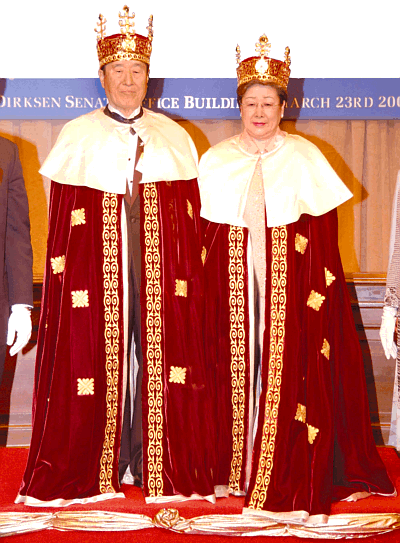
A ginormous portrait of Moon hangs on the back wall, occupying one half of the stage: He and his wife are adorned in white robes with vertical gold lines, white crowns like the Burger King crown, and a big smile.

The service continues with praise songs: “In my heart of hearts, Father, I pledge my life to you.” Father, in this case, refers to Rev. Moon, not the God of Abraham.

The members read the Family Pledge, first in phonetic Korean and then in English.

After a number of songs, the service leads to a very Catholic ritual: the shaking of one’s neighbor’s hands. However, there is no accompanying phrase like the Catholic Mass, “May the Lord be with you.” So, I improvise, “May the True Father be with you!” No one repeats my phrase.

A pregnant pause.

Minister Gam, with a heavy African accent, (which is 80% incomprehensible) introduces himself to John and me. He is a friendly soul with glasses and could just as easily be a Catholic Priest in another time and place.

Another speaker makes some announcements about upcoming workshops and moving sales.

The announcement in the back of the program reads,

“Pledge Service To Be Held Every Eight Days on Ahn Shi II—On April 19th, 2004, on True Parents’ Day Father proclaimed that the time of the Sabbath as one day has been fulfilled and we are now in the era when every day should be the Sabbath. From April 19th Father proclaimed that every eight days will be the day in which we conduct the Cheon II Guk Pledge. (Sunday will no longer be the pledge.) April 27th Father held the first such pledge service. On May 5th Father held the second Pledge Service and on that eight day, Wednesday, May 5th Father conducted the commencement of the Ahn Shi II…”


Let’s fill this room!
Rev. John Dickson delivers the sermon with a constant smile. He is upbeat, wears a khaki sports jacket sans tie. In his mid to late 40s, he speaks with a gentle cadence. By now, the room grows to about 30 people.


His original degree was in architecture at Cornell. He recounted the story of how Cornell built a new wing to a building. “The builders planted grass and waited one year. They built the sidewalk over the areas where the grass did not grow.” He continued with the building metaphor.

“We’ve built the house. The foundation is complete. Now we need carpenters and electricians.”

“Father Moon says, once the marrow has left the bone, it’s done. There are 6.5 billion people who struggle in agony and sin. Your third mission is to ‘bring them home.’ After all, they are our brothers and sisters.”

Referring to the giant portrait of Rev. Moon and his wife behind him, Dickson asks, “Have you ever seen a picture of George Bush this big? Or George Washington? Or Lincoln? For Americans to come into this culture, it’s a difficult thing. We’re all very different.”

Unlike Joseph, the reverend praises the neighborhood’s linguistic diversity. “You almost never hear English in this neighborhood. For example, a German guy was asking an Ethiopian and Hispanic for directions to downtown DC.”

He discussed their goals and how to accomplish them.

“Lenin and Stalin were imitations of the ideal of showing the world ie Satan.” Rev. Dickson was in Romania one week after their dictator Caecescu was shot. “I went into the palace, which is big enough for you to park a 747 airplane. We overthrew the Kings. George Washington gave up power after two terms. That was the biggest revolution.”

Sweet Potato Search
“How many people were born in the US?” he begins. Four hands go up. “Notice I did not ask how many people are American! My wife speaks English, and is from England. Women come from a much more different culture than people from another country.”

Reverend Dickson describes the sweet potato and how its roots are connected to other sweet potatoes underground. “Be careful not to yank it out. Pull it out gently.” Once you do this, then you can reach other sweet potatoes. “That’s what we do wrong now. We yank it out.” In other words, don’t be too forceful when talking to non-Moonies about the movement or you risk offending them.

“Don’t expect Father Moon to be popular. You know my biggest fear when I joined this movement?”

A pregnant pause.

“That it would become popular!”

Laughter.

Dickson dispensed some advice on dealing with powerful people in Washington, DC. “I always get introduced to them.” He gave the example of Frank Carlucci, former Secretary of Defense under President Ronald Reagan, claiming him as a “friend of mine.” Since Carlucci knows many other powerful people, it is much easier for them to accept him if Carlucci makes the introduction.

After the introduction, Dickson can then ask the new person, “Do you know someone who would like to go to the Bahamas to discuss the nature of God?” If they want to go, “they’ll tell you.” He continues, “I invite everyone to everything.” That way, there’s no obligation. For example, I send you to Korea for one week, then you come back and feel like you owe me.

“We only have 7 years and 6.5 billion people. Don’t wait! It’s time now.” We’re building. We’re above ground now.” He encourages the people in the room to recruit new members, “Let’s lift this screen. We almost filled the room today. Invite a friend.” Expressing his admiration for his parishioners, he waxed, “I appreciate all of you. You’re so special! You’re willing to do this even though it’s not your own culture. God bless you!”

He stated that the unification of the spirit world is not complete. He ended by alluding to a popular view of insanity: if you do the same things over and over again, but expect different results. In other words, it’s time to try a new approach to expand membership.

Concluding prayers
“Heavenly Father—thank you for loving us. We offer you our whole family, and our future is to invite those 6.5 Billion people home to know you.”

In the gift shop, I discover the book, The Role of a True Wife, a collection of thoughts by one of Moon’s disciples on the role of a Moonie wife. For example, it teaches that a wife should always be affectionate with her husband; furthermore, she should never sleep in bed with her back to her man. It also expounds on the health benefits of massaging one’s intestines.

One gentleman asks us if we are first or second generation? I reply “second,” thinking he is asking about my immigration background. John explains to me later that in reality, he wants to know if I am a convert or the child of Moonie converts.

He invites us to lunch in the basement dining room. We decline as we head out the door. Maybe next time. Besides, I want to introduce John to Ercilia’s, the best pupuseria restaurant in the Mt. Pleasant neighborhood that serves up El Savodorean pancakes. At least I know what ingredients go into making them.

* * *

If you want to become a Moonie or join the True Family, go to:
1610 Columbia Rd NW, Washington, 20009 - (202) 462-5700

They welcome new victims…er, ah recruits. If you join, that’s one down and only 6,499,999,999 more to go.

Here are some websites for more information.

Salon article

http://www.washingtonpost.com/wp-srv/national/longterm/cult/unification/main.htm

http://www.unification.org/

http://www.rapidnet.com/~jbeard/bdm/Cults/unificat.htm

http://www.iapprovethismessiah.com/

Monday, September 11, 2006

Test Drive: DC Chinatown bus trip to Philadelphia


Sunday 8/27/06

As I stood in line to board the Chinatown bus, I asked the fellow in front, “Is this the Philadelphia bus?”

He shrugged his shoulders, “I don’t know.”

“You’re late!” the ticket collector bellowed.

“There’s still 10 minutes before you leave,” I replied. “Yes, but you’re supposed to be here 30 minutes before departure,” he reprimanded me as he took my ticket. As we were about to leave, two more passengers knocked on the door. The bus driver told them, “We’re full.”

“I have a ticket,” he responded.

“You’re late! We’re leaving now,” our bus driver barked, a bit upset.

“But my bags are already on the bus. I walked away for a few minutes to get something,” the late passenger tried to explain.

At this point, he and the bus driver raised their voices. Expletives were exchanged. Passengers craned their necks or stood up to see the commotion. It was unclear exactly, but I suspect the bus driver removed the late passenger’s bags. We took off—5 minutes early.

When we arrived at Baltimore, we picked up a few more passengers. Another man relieved our bus driver. I recognized him as the fellow in front of me in line. However, he sat there for a brief moment before the first driver told him--in Chinese--to release the emergency brakes. The first driver stood on the steps by the door for a few minutes, monitoring his replacement’s progress.

“Don’t follow the other car so closely,” he warned his friend. Soon, he sat down to read his newspapers.

The bus proceeded quite smoothly for another hour or so. Shortly before we arrived in Philadelphia, the driver pulled the bus onto the shoulder and exchanged positions again with the first driver. We arrived in Philadelphia at 2:15pm--exactly as scheduled.

Thursday, September 07, 2006

Tea Time with Ms. Nien Cheng 8/19/06

Preparing for my Shanghai trip
Prior to my business trip to Shanghai in April 2006, I wanted to read up on the city’s political and social history. I peered through my book shelf and saw a copy of Life and Death in Shanghai by Nien Cheng. I had bought the book a few years ago from a library book sale because it looked like an interesting read; however, I had never read the book. So, I thought this was a good opportunity for me to educate myself on a slice of Shanghai ’s past.

Cheng's book recounts in compelling details her persecution and imprisonment at the hands of Mao Zedong's red guards in the "Cultural Revolution" (1966-1976). Inquisitors accused her of being an “imperial spy,” but she never gave in during her six years of solitary confinement. Her only daughter Meiping was murdered in the first year of her incarceration, but she did not find out until shortly before she was released. The Library Journal wrote, “We read this, not so much for historical analysis, but, like the literature of the Gulag in Russia, for an example of a humane spirit telling terrible truths honestly, without bitterness or cynicism.”

I stayed up all night to read the final 150 pages of the 560 page book. It sounds trite, but I could not put the book down. Parts of her book will make you cry. When I finished the book, I was so moved that I wanted to see if the author was still alive. She was 71 when the book was published in 1986, so she would be 91 now. Instinctively, I googled her. I found a DC address and a phone number. When I called, an elderly woman’s voice was on the outgoing message, “Please leave your name and number.” So, I suspected that she was still alive. I wrote her a little note thanking her for writing the book. I also wrote that if it is possible, it would be my honor to meet her one day. I did not expect a reply.

That Memorial Day weekend, I went hiking in the mountains of Western Maine . When I returned, I found a message in my email account from the author. She wrote that ever since her book was published, she has never refused to see a reader. “I am honored when a reader wants to see me. Generally they are interested in China. Usually they are full of interesting questions.”

Nien’s friends have cautioned her on welcoming so many visitors: “They ask me, ‘why do you let all these visitors come? What if they kill you?’ But, why would they do that? I’ve never done anyone wrong.”

The meeting
After a few months of email exchanges, we finally settled on an afternoon meeting for August 19, 2006 .

When I meet her, I shake her hands. They are pale and slightly gnarled—the result of arthritis compounded by six years of torture at the hands of fanatical red guards. “It is an honor to meet you,” I began.

“It is good to meet you. It is always good to see young Chinese. You know, most of my visitors are American (meaning, non-Chinese).”

At 91, Nien appears to be more energetic than many 70 year olds. She is skinny, upbeat and very lucid. Her hair is now completely white. Glasses sit atop her sharp nose. She speaks in a cheerful tone with a slight British accent.

“Should I take my shoes off?” I ask politely.

There are fresh vacuum tracks on the blue-green carpet. “No, that’s not necessary,” she says as she invites me in to sit down on the couch. She walks to the kitchen to prepare tea.

Her living room walls are decorated with various Chinese scrolls. On one side of the room by the door, books line the shelves. I see a few Chinese end tables here and there.

I take out my two prepared gifts: a small package of baklava from my corner Halal meat store and a package of Taiwan ’s High Mountain green tea. She accepts the baklava, having never eaten it before, but declines the tea. I think she is just being polite. “You must accept the tea,” I insist.

“I cannot. It’s a medical condition—I’ll explain.”

She serves me a huge piece of Black Forest chocolate cake with frosting and two cups of tea. When I begin to drink, she explains that both cups of tea are for me. She cannot drink tea. She had one of her kidneys removed many years ago. Since then, her doctor has advised her to abstain from tea, since the acid will build up in her remaining kidney and eventually damage it, killing her. “From the time my kidney fails to my death, there will be about three days,” she explains in a matter-of-fact way.

Schooling
As a young woman, she studied at the Yan J ing University in Shandong Province . Her father, who was fond of Britain , sent her to study at one of England ’s finest Universities. People in England , he said, knew their places in society. In other words, he preferred the class distinctions. (Nien observed however, that the US is special because “in one generation, you can do better than your parents.”)

Her tutor at the London School of Economics could not pronounce her name Yao Nien Yuan, so suggested that she adopt “Nancy” or “Nina.” She refused. She asked her tutor to simply call her Nien. In time, she would take her husband’s surname Cheng to form Nien Cheng. However, to her American friends now, she is known simply as Nien.

While at School in London , she met a young Mr. Cheng, whom she would eventually marry. He invited her to movies and dinners and would go to the country with her on a green bus only after lunch because of his morning church service. A religious man, he began to invite Nien to his Presbyterian Church service. Despite a Buddhist mother and a non-religious father, she would eventually adopt Christianity. She is now Methodist.

A Return Visit to England
In the mid 1980s, She made a visit to some friends and former coworkers from Shell Oil, her old company. While staying at their home, the daughter of her hosts was also visiting from school. She invited along her friend, who was in the book publishing business. When Nien recounted her story and her completed manuscript, the daughter’s friend wanted to read it. Nien promised to send her a copy.

After she returned to DC, she went to the post office to post a copy of the manuscript to London . “At the time, I did not have much money,” recounted Ms. Cheng. The package would cost her about $20. She asked for a lower rate. The clerk explained that the lowest rate was surface or about $6.00, which sounded like a much more reasonable figure to the cash-strapped author. She understood that at the surface rate, the package could easily take a month or more to make its way to London on a ship.

Later, she received a phone call from London . It was the book publisher. “Nien—have you had a chance to post the manuscript yet?”

Nien explained that she had indeed, about a week earlier.

“But, I have not yet received it,” she replied.

“I sent it by surface,” Nien explained.

Her book publishing friend was stupefied.

After the manuscript arrived safely and the book publishing friend read it, she offered Nien £30,000 (In today’s currency, accounting for inflation, this amount is roughly $100,000). Having never published or sold a manuscript before, Nien consulted some friends in New York City . Both of them advised her to accept right away for some key reasons: first, since she was an unknown author, many publishers would not take a chance on her. Second, £30,000 wasn’t a bad amount for a first book. Once the book came out, it became a bestseller. Soon, publishers in the US and Australia wanted to buy the rights to her manuscript.

Lecture circuit
The speaking invitations arrived shortly after the book was published. First, it was the Universities. So, Nien traveled across the country speaking to young people about her story. Then, corporations and businesses came calling, asking her to speak to their conventions. She traveled to Japan and many other places for a few years. In Japan , she delivered five speeches at $10,000 each.

One year, President Ronald Reagan invited her to a state dinner. She sat to one side and another guest from Central America sat to his other side. However, the other guest spoke no English, so required a translator. So, President Reagan was more comfortable speaking with Nien the entire night.

She served on a special government commission to sponsor a radio program that would be broadcast to the Chinese. Similar to the Voice of America, the program would teach democracy to the Chinese audience. Senator Joseph Biden (D-Delaware) sponsored the legislation creating the program. To dedicate herself fully to this government appointment, she cancelled her speaking engagements for the year.

Nien believes her book has been more successful than other accounts of the Cultural Revolution for two reasons. First, her book contains historic background besides an account of her personal suffering. Understandably, her book is used in high school classrooms and universities to study the Cultural Revolution. Second, she did not use too many Chinese names, which can be very confusing for Western readers. For example, she would introduce her cook as Lao Zhao, but thereafter refer to him simply as “the cook.” Nien recently bought three copies of the new book Mao: The Unknown Story, by Jung Chung. She kept one for herself, but gave away two to friends. One friend says she cannot finish the book because “there are too many names for her to keep track of.”

Forgiveness
I’ve found that forgiveness is a strong theme in Christianity. In 1981, Pope John Paul II survived an assassination attempt. Two years later, he forgave his would-be assassin and even met with him in prison, saying “I spoke to him as a brother whom I have pardoned and who has my complete trust." What feelings does Nien hold for her red guard tormentors? Surprisingly, Nien says she has forgiven them, saying simply, “They were doing their jobs.” However, “I cannot forgive my daughter’s murderer.”

Departure
I pull out my copy of her book and ask for her autograph. She takes the book to her living room table.

“What is today’s date?” Nien asks me as she begins to pen her note and autograph to me.

“August 19.” I reply.

“Yesterday was my daughter’s birthday,” she says softly.

I do a quick calculation in my head. Her daughter Meiping would be about 60 had she lived.

“Please come back in a few months, maybe late September or October and tell me how your law school plans go. I’ve given up driving, so if you come with a car, we can go to dinner at a Chinese restaurant.”

I thank her and shake her hand a final time. These are the hands that typed up her manuscript five times on a manual typewriter.

I look at my watch -- 8:20pm . Four hours have passed.

I leave feeling that I’ve been blessed by meeting a graceful lady, whose best revenge of all may be that she has outlived her tormentors. I detect not a hint of anger or bitterness at those who caused her so much pain.

She has already suffered enough for many lifetimes. She lost her home, her liberty, her daughter and nearly lost her life. Despite all these setbacks, Nien maintains a remarkably optimistic Life Philosophy: everyday is a new day. Naturally, on the front cover of the book, she is smiling in her picture. I now know why.

Shanghai Sojourn: April 2006


Introduction
In mid April, I had the pleasure to travel to Shanghai, China for a week to speak to the Shanghai Institute for International Strategic Studies on US-China relations and American Democracy Export. The institute was particularly interested in my work for the International Republican Institute, which promotes democracy worldwide.

The day before I departed for Shanghai, I met with a state department friend who advised me to cancel the trip. He believed this was a classic case of a foreign government making me an asset or gathering information from me in the guise of an academic trip.

He cautioned me, "they know a LOT about our political party system and we know next to nothing about theirs, so why give away the playbook?" I responded that I would only tell them what can be found through a google search.

However, if I do go, then I should

*Not accept the reimbursement for my travel costs, which is usually in cash.
*I should also not accept the offer of a car or driver/minder to travel with me for sightseeing.
*I should not make any phone calls from my government hotel as it is most likely bugged

He also warned me that every few hours, I may receive phone calls in my room asking me if I want a massage. Some visitors fall for this tactic, which is used to obtain sensitive information. After our talk, I became a bit paranoid. If my hosts had such devious motives, then perhaps I really should cancel. However, after some more thought, I decided to go after all. It was a rare opportunity for cultural exchange.

My official talk would be the Monday after my arrival. After that, I was free and on my own, but being kind Chinese hosts, they wanted to send one of their staff to "take care of me" by accompanying me to the neighboring cities Suzhou and Hangzhou, even though that part is personal sight seeing. They also would book the hotels in those cities, too.

Day 1: Sunday, 4-16-06
Arrival at Pudong Airport
Johnson Hu, the research institute's assistant, waits for me with a piece of paper with my name. He is in a quiet area apart from where the general public has to wait for arrivals. Johnson is dressed in a dark suit and tie. He is 35, but his glasses give him a younger, engineer look. He leads me to the parking garage where a car and driver pick us up.

Johnson is from Hefei, the capital of Anhui Province. He's resided in Shanghai for the last 10 years. He wears a short haircut and speaks fairly fluent, but methodical English. He tells me that he's visited the US for two weeks in 2002: DC, Boston, New York, Las Vegas. (Somehow, most Chinese delegations to the US must include a stopover in sin city.) When he was in DC, he got a view of the US Congress and the White House only from the outside. I told him, "For your next visit, please call me and I'll take you inside the Capitol."

Johnson asks me if I speak Chinese. I respond modestly, "mama huhu," or not very well. We continue our conversation in English.

As we leave the airport for the heart of Shanghai , Johnson explains that the current airport is only 1/3 complete. It will be some time before it is completely built. However, in China "some time" can mean a short time. As we cross the Huangpu river I see cranes dotting the landscape. Johnson delivers me to the Equatorial Hotel and says he will pick me up in the morning.

Dinner with Tony Chen

Tony used to be the Asian American outreach liaison at the Republican National Committee (RNC) under the first Bush Administration. When I was doing Asian American outreach for the RNC in 2002, I would always hear the name Tony Chen when I traveled the country to meet key Asian American leaders. I finally met Tony a few years ago when he returned to DC for a short visit. We've stayed in touch ever since. Tony is the one who recommended me as a speaker to the institute. In his mid 40s, Tony speaks with a soft, but clear voice. He's been in Shanghai for the last decade working for a few companies, including Yum Foods, which owns Kentucky Fried Chicken.

Tony came to the Equatorial Hotel after 7pm to see me. The Shanghai Foreign Affairs office runs the four star hotel. In its day, it used to be the best Shanghai had to offer Foreigners, but it is now eclipsed by the Hilton Hotel behind it. For a government hotel, the Equatorial feels like a five star facility. One night's stay runs about 800RMB or about $100.

We walk on the people bridge, past the park and toward the mall. Tony's advice to me when I'm walking on the people bridge: avoid the street vendors from Xin Jiang province (next to Tibet). They're usually Hui Minorities and are "very aggressive." A few Chinese men push business cards toward any foreigners who walk by, usually to sell airplane tickets or watches.

The first place we go to has shut down. And the second place is not open until two days later. So, we go to the closest Shanghai restaurant on the block. At dinner, Tony gives me a quick lesson on Chinese lecture etiquette. During my talk, I should not be surprised if a cell phone or two goes off and they speak in the room. Or, if participants fall asleep during my talk. Apparently, this is quite common in Chinese symposiums. Tony alerted me that the institute had one objection to one slide in my PowerPoint presentation: a cartoon depicting President Hu Jintao as an angry dragon when meeting with President Bush. I agreed to remove it for the good of US-China relations.

When Tony first arrived in shanghai many years ago, he had a horrific experience at a Karaoke club. The manager tried to bully him to pay 10,000RMB (about $1250) for a few drinks. He closed the door and had couple of his goons show up to scare Tony. Fortunately, for Tony, he was a smooth talker. He pulled out his US passport and told the manager that he was a US Government Official. "If you don't let me out right now, then this place will be closed down tomorrow!" They released him immediately.

Despite the warnings about safety, Tony reassures me that Shanghai has a great reputation as a fairly safe city. With that, we take a taxi back to the hotel and I prepare for the big day.

Day 2: Monday, 4-17-06
The Lecture

Johnson takes me to the nearby research institute to meet director Xia Liping, an amiable gentleman with a big smile. He is from Fuzhou, Fujian province, right across Taiwan. He is perhaps in his 50s, but like most Chinese, looks 10 years younger than his actual age. Must be the tea and tofu. He has taught at the Defense University in Beijing and travels to the US quite often, at least once a year.

Mr. Xia greets me warmly, "A real pleasure to meet you!"

I respond, "You honor me by inviting me."

He asks me about my background. I explain briefly how my family moved in 1982 from Hunan Province in the People's Republic of China to the People's Republic of Berkeley, California.

Mr. Xia reveals that he lived in the US for one year and conducted research with the Atlantic Office. He presented me with a little bag with some academic journals; one journal was in Chinese.

Mr. Xia asks what I expect from President Hu's visit to Washington, DC later in the week. I explain that it would be about 20% substance and 80% fluff. He quizzed me on American views of China: "Is the US-China relationship competitive or cooperative?" I explained that it is both. The relationship is dynamic and very fluid. It shifts depending on the crisis at hand.

After an hour of pleasantries and chit-chat, I return to the hotel for lunch and prepare for my 2 pm talk.

About 18 academics show up for my talk. They are mostly middle-aged, but a few are in their 30s. To give you an idea of what I spoke about, I include only the beginning part of my speech:

Speech Introduction

Thank you to Mr. Tony Chen for inviting me. And thank you to Mr. Xia Li Ping for hosting me. And thank you to Mr. Johnson Hu for picking me up at the airport. I know that it is not an easy job. I used to do the same job when I was at DiCon Fiberoptics, my first office in Berkeley, picking up French interns at SFO.

I am very honored to be able to talk to you today. There is an English proverb, "experts come from out of town." So, perhaps that is why you think I know something about the topics of which I am about to discuss today.

President Hu Jintao is on his way to the US, starting in Seattle on 4/18 and arriving in DC 4/20 to see his old friend President Bush. So, it is appropriate that we are discussing US-China relations.

When Wen Jia Bao visited 12/2003, I had the pleasure to see him at the White House. While I cannot be present this time to welcome President Hu Jintao in DC, you and I can wish him and President Bush well in their visit.

The last time I visited Shanghai was 1/99 when I came for a week with friends. It was during winter break right before Spring Festival and I stayed at a youth hostel on the Wai Tan (Bund). I shared my room with 7 people: 3 Japanese students and 2 Europeans and my teaching friends. One bathroom. Now, I have my own room at the Shanghai Equatorial Hotel and Mr. Johnson to show me the city. What a difference!

Like old friends, the US and China have many shared interests and a shared future. And like married couples, they also have disagreements and the occasional fights, but we realize that a divorce is not possible, for now. I can say this because I am the product of both countries, both cultures, both peoples.

I was born in Hunan Province, famous for spice and being the home of modern China's most prominent native son--revolutionary leader and Chairman Mao Zhu Xi. Hunan also gave us Mr. Lei Feng (a young soldier who died in the 1960s, but has since been lionized by the Communist Party as the ideal socialist martyr), a very popular comrade and I've been told, may be related to me.

I was raised in Berkeley, CA--birth of the Free Speech Movement and home to more socialists than all of China now. The City is named after the Irishman George Berkeley, who is also considered by some to be the first great American philosopher.

I taught English in Huadu (or flower capital), home of Mr. Hong Xiu Quan, the revolutionary leader of the Taiping Rebellion that challenged the Qing Dynasty in the late 1800s.

I have lived and worked for more than four years in Washington, DC ¨C named after our first President and leader of the American colonies fighting to expel the British Crown during the Revolutionary War.

And now, I've come to Shanghai, the birthplace of the Chinese Communist Party in 1921 and now leading China's economic engine to a brighter future. And home to author Lu Xun, my favorite modern Chinese writer. As you can see, I have a very strong attraction to revolution!

However, today's talk is not about me; rather, this talk is about living in revolutionary times and momentous changes. Recent historians in the West have called the 19th century the European Century, the 20th century the American Century and the 21st century the Asian Century. Let me modify this characterization by saying it will be the CHINESE century and Shanghai is at the heart of that century.

* * *

They nod politely.

An old timer in the back falls asleep about 5 minutes after I begin. Johnson's cell phone rings, but he is polite enough to step outside the room to talk.

The talk concludes about 3:30pm. I answer three questions.

Evening dinner

Mr. Xia and Johnson take me to a restaurant serving Shanghai Cuisine.

Mr. Xia has visited North Korea's Kim Kong region, known for its hot springs. He relates to me his experience of interacting with the North Korean people.

I ask Mr. Xia about corruption in the Chinese government, "How do you control it?"

"We're tried morality, but that is not working well," He stated.

Moving on to lighter subjects, Mr. Xia asks me the typical Chinese question, "do you have a girlfriend?"

"No." I respond.

After a few moments, I ask Mr. Xia the same question. "Do you have a girlfriend?" He laughs, but does not give me an answer.

"Are you marrying Chinese?" He probes further.

"I am an equal opportunity dater. If there is a beautiful woman, Chinese or Western, then I will consider her," I explain.

Day 3: Tuesday, 4-18-06
A stroll on Nanjing Road

I am in Shanghai, the new financial capital of China. Life flows all around me; it wells up from the subway exits, a constant wave, descending from stairs. I see it everywhere: Traffic. Babies. Food. Gucci Ads. Vendors. Traffic. Beggars. Life. Life coming upon me. Each face looks exactly like mine. No one looks at me.

I pass a mother and child sitting on the sidewalk. The little one is maybe two years old. Mom wears a red cap and holds out a paper cup, but her swollen red cheeks face the sidewalk. She has that look. The look of desperation. Pedestrians pass her by. I watch her for a few minutes from the corner. This morning, I gave my dinner leftovers to the old beggar by my hotel. I wished I had some more to give to mom.

An old traveler I met in Beijing once told me that the best part of visiting a city is to peek into the alleyways and see what people are really up to. Following his advice, I enter an alleyway off of the main road. A cobbler has set up shop at the entrance out in the open. He has a shoe stand and some old shoes to the side. A young lady stops by. Inside the alleyway are mundane items you can find in alleyways anywhere in the world: laundry hanging on rope lines. Three old men in shorts and T-shirt playing a game of chess on a table that's too low for them. A bulletin board warns, "maintain fire safety: regular meeting this Friday." An art shop displays Western paintings, oil on canvas.

Pearl Orient tower

Standing at 468 meters tall, the Pearl Orient TV Tower is the highest tower in Asia, but the third highest in the world.

It shoots straight up like a rocket, but most observers have compared it to a futuristic space ship from a science fiction movie. To get in, I paid the basic price of 70RMB (about $9), which allowed me to go the middle ball and to have a panoramic view of the city.


On the windows of the observation deck are etched purple lettering in both Chinese and English:
West: Guangdong, Guangzhou 1260KM

South: Taiwan, Taibei 680KM

East: Dozens of ships and barges dot the Huang pu river, racing toward the ocean. Those ships enter the Huang pu like they're on a never-ending conveyor belt. I see a construction site below and catch the light from a welder's torch.

North: Liaoning Province, Shenyang 1033 KM

Plastic flowers line the deck, evenly spaced every 5 feet or so. Tourists have a camera or camcorder attached to their hands. Each group bears a different accent.

Day 4: Wednesday, 4-19-06
Train ride from Shanghai to Hangzhou


Mr. Yang, the institute driver takes me to the North train station, where I wait along with thousands of other travelers. He is a native of Hebei Province, Central China. In his late 30s, Mr. Yang earns about 3000RMB a month (about $400). "Can you support a family with that?" I inquire. He says that 2000RMB a month is sufficient to support a family, even in Shanghai . He wishes me a good trip and we will meet up in Suzhou on Friday.

A female voice announces the bad news: our train is delayed by 30 minutes. The family of three in front of me is upset: "It can't be! It can't be late." When I ask the woman if she's going to Hangzhou for business or pleasure, she replies that she has some "affairs over there." Chinese are rarely polite or detailed with strangers.

Once the gates open, the crush of people rush through like lemmings.

At the train door, passengers elbow their way pass the conductor and onto the train. The conductor admonishes them: "No pushing. Everyone will be able to board."

We are traveling about 20 miles an hour. The train passes by fields of green (rice fields), brown (warehouses) and white (tiled farm houses which have replaced mud huts). I am sitting in the middle seat of the hard seat section of the train. I see three passengers around me talking on their cell phones. Two people who have no seats are standing in the aisles. The music shifts from a pop song to one without lyrics¡ªa plaintive piano song. A young vendor with an untucked, white shirt patrols the aisles peddling bottled water inside a basket.

The man across from me is perhaps in his early 30s. He wears jeans and is reading a Chinese newspaper. The man on my right is also buried in his newspaper. The young lady to my left, by the window is busy writing numbers on her papers. She must be in her mid 20s and peers intently through her spectacles at her documents, which are covered with clothing design samples: bits of burberry and plaid patterns fill the pages. She has curly, brown hair and glances outside the window occasionally.

Cigarette smoke fills the cabin and the music now switches to Beijing Opera. The TV screen hangs from the ceiling. Knees knock together. The cabin fills with the sound of seeds hitting the floor. Chew chew chew. Crackle. Cough. Cough.

One rider across the aisle discovers he's on the wrong train. He has a ticket for train 739, but we're on train 743. His destination is Nanjing, north of Shanghai. We're heading south. His seatmates laugh at him. He complains to the conductor that "those train clerks told me to get on this train!"

A young man across from me strikes up a conversation. He is darker than the other Chinese and wears black-rimmed glasses. He has spiky black hair. A fourth year Chemistry student at the University, he is returning to Wuhan, the capital of Hubei Province. He worked in a factory job for two months, but did not like it. "I want a job in sales after graduation," he tells me with a smile.

I tell him that I studied history at the University. He laughs. He's incredulous that people still study such a subject.

"And what do you do with a history major?" he inquires.

"I taught school for a year." I explained.

"Sounds right. That's what they usually do," he added.

More sounds of seeds hitting the floor. Chew chew. Crackle Crackle. Cough. Cough.

Conductor announces: "We'll arrive in about an hour." We now are traveling about 40 miles an hour and pass by more rice fields and some greenhouses in white tents.

Fashion designer girl barks into her cell phone: "I need 5050 model type. I'm on the train now."

Another vendor makes a special presentation to sell cotton socks. He passes the samples around.

We finally arrive in Hangzhou's East Station a little after 1:30pm. Outside the station, I see the Chemistry student again. He introduces himself as Mr. Lu. Before we part ways, he wishes me a safe journey: "Yi lu pin an." I head for the taxi stand.

Lily Shentu: A friend of a friend of a friend
Lily is the student of Timilin, the girlfriend (and now fiancee) of John Koehn, my friend and Oregon Victory campaign colleague. Before I headed out on my trip, I asked Timilin if she could offer me any insights on the Shanghai area.

She kindly provided me the name of her former Ningbo University student Lily, who would be able to show me around Hangzhou. Lily and I spoke by phone when I was still in Shanghai. She was generous enough to reserve a room for me at a local youth hostel. She wanted to meet me at the train station, but also had a job interview that day. She did not yet have a time for the interview, so tried to have a friend of hers meet me. I told her that it was unnecessary and too much trouble to meet me at the train station. It would be much easier to simply meet me at the youth hostel.

After a long taxi ride (50RMB), I finally arrive at Jiang Nan Yi Youth Hostel. As I am checking in at the counter, a young lady in denim shorts and a silk black top from behind greets me. "Hi Andy!" It is Lily. Her face radiates a big smile.

She explains that her interview finished early, so she decided to meet me at the train station after all. She had written my name with a neon green marker on a 8.5 x 11 piece of paper and stood at the train station exit, hoping to meet me. We probably missed each other by a few minutes and a few feet.

I give Lily the package that Timilin had entrusted to me to deliver to her student: some jelly belly beans and some other knick-knacks. After I place my bags in my room, we sit down on the deck for a few minutes. Lily takes out a bright, gold pen to write on her notebook. "Wow. That's the brightest gold pen I've ever seen." I exclaim.

"My father gave it to me." She explains.
"It looks like an executive pen." I remark.
Lily handed the pen to me: "Then, it's yours."
"No, I can not take it from you." I protest.
She insisted. I refused a couple more times before I accept.
"I better be careful about what I say I like about you." I joked.

Lily accompanies me on a leisure walk by West Lake on the South Line, a newly-built path that is dotted with Willow trees and offers a breath-taking view of the lake. President Nixon visited this city and even took a boat ride on the lake in February 1972, when it was still in the middle of winter.

After our walk, Lily and I board the bus to go to her home, where she changes into something warmer. When she came out, She handed me a tea gift bag. We return to the youth hostel for dinner.

Lily is starting a new job as a translator for the Hangzhou World Expo Leisure Fair that will run for the next 6 months. It is an excellent opportunity for her to practice her English skills. Since she graduated last year, she has not had too many chances to speak English.

After dinner, Lily takes me on a leisure walk by West Lake.

Day 5: Thursday, 4-20-06
Exploring Hangzhou

Lily and I meet in the morning in downtown. She takes me to the fairgrounds where the World Expo will take place. We pass various vendors and kiosks. I have not yet had breakfast, so I stop by a dumpling stand where I pick up a few jiaozi and quickly wolf them down. Lily watches me, but has already had her breakfast.

Lily then takes me to the Hu Pao Yuan or the Running Tiger Garden. It reminds me of that scene in Crouching Tiger, Hidden Dragon when the characters played by Michelle Yeoh and Chow Yun Fat are resting in a simple open structure in the bamboo forest. It is the essence of serenity. A light breeze blows. A little brook babbles its way past the footpath. The air is fresh and I feel like I am the first person to step here in a hundred years.

About 1:00pm, Lily has to leave for her office, but she suggests we meet up again tonight about 9 or 10pm. She suggests a few places that I can visit for the afternoon. However, I miss my bus stop and wind up in the wrong part of the city. A few more wrong buses and I wind up at Zhejiang University campus. After an hour or so of riding wrong buses, I finally get to the Su Ti garden. In mid afternoon, I return to the Youth Hostel to take a nap.

When I wake up, it's already past 8pm. I go downstairs for dinner and then call Lily again. She asks that I meet her about 10pm at the Italian Restaurant on the South Line.

Just at this time, President Hu Jintao's state visit to the United States is broadcast on Chinese TV. CCTV, the state-controlled TV News Station shows Hu as a great hero, being well-received by the American president. The chatter among Chinese is that President Bush's approval ratings went up in China after the visit. Perhaps, he is more popular in China than the US? As you can see, the Chinese greatly value China-US Relations, much more so than most Americans, I believe.

Day 6: Friday 4/21/06
Touch the people: Hangzhou to Suzhou

Lily and I meet for a final breakfast at a "da pai dang" or little eatery. She orders a special chicken soup for me that was quite sweet. We both have a sizable plate of hand-made noodles or "la-mian." After breakfast, she boards the bus to go to work and I hop into a cab headed for the train station. I tell Lily that I will miss her company when I'm gone.

When I arrive at the station, the ticket seller, in a Greyhound bus driver tone-of-voice, announces that the next train is 12:45pm, arriving in Suzhou about 3pm. Not wanting to wait so long, I knew I had to get a bus. However, to save a few dollars, I go to the public bus stop nearby. Just as I approach the No. 512 bus stop, it pulls out with a full load. So, I wait along with farmers with big plastic bags and split bamboo poles, young men with unkempt hair, ruffians with shifty eyes. Whenever I travel, I usually want to "touch the people" and to see how the common man travels. Well, now that I am among the people again, I realize that they frighten me.

The bus finally pulls up and I board. Luckily, I get a window seat. On the third stop, I get off and buy a ticket at the bus station. The clerk tells me that I better hurry as my bus is pulling out in a few minutes. A short, middle-aged lady asks me to follow her as we race through some tight alley-ways, littered with water and trash. After a few minutes, we arrive at a small van. I get in. I'm relieved that we are now on our way to Suzhou at last. We pull out of the station and drive a few blocks before we pull into another neighborhood with small streets. The driver tells us to get out and transfer onto a bigger bus. Once onboard, we get onto the highway.

An hour into the drive, we stop at a toll booth. Then, we pull to the side of the road for a few minutes for "inspection." A man comes to the side of the bus and asks the driver to open the doors so he can examine the luggage to see that no explosives or dangerous items are onboard. A few minutes pass. We're back on the road. One more hour passes. We should be very close to Suzhou by now. The driver pulls the bus to the side of the road and yells out: "Those of you going to Suzhou¡ªwe're here! Get out now."

A few passengers ask the driver, "Wait a minute! Aren't we going to the main bus terminal in town? This is still the highway outside the city!"

The driver responds, "We're not going to the bus station. Besides, we're right outside the city and the public bus stop is right here. Get on the public bus, which will take you inside the city. Get off now!"

About 10 farmers get off, many of them visibly upset and cursing, "Ta ma de," which translates roughly into "motherfucker." I get off with the farmers. The bus pulls away. For a few moments, everyone looks dazed. We now realize that we've been riding a bus without a permit. Some farmers cross the highway. A few look at a map to figure out exactly where they are. I go to the nearby convenience store to ask for directions. Sure enough, we are right outside Suzhou. I decided to wait for the public bus along with the rest of the group. Fortunately, the public bus comes on a frequent basis. We take the bus into town. I hail a cab, which takes me to the Gloria Hotel, which costs 1000RMB for the night.

I don't yet see Johnson or the driver anywhere, but my room has been paid for already. After resting a bit and sending some emails, I decide to go walking about town. I visit the Humble Administrator's Garden, built in the Ming Dynasty by a retired scholar-official.

I contemplate my visit to these two cities: how wonderful travel is¡ªthe way it shakes you from your normal everyday routine and allows you to examine your life from another perspective. The Chinese have a famous proverb, "Up above there's paradise, down below there's Suzhou and Hangzhou." Now that I've visited both cities, I truly understand this saying.

Day 7: Saturday, 4/22/06
Return to Shanghai

Johnson and the driver Mr. Yang drive me back to Shanghai. Johnson has to take off for Beijing for a business trip, so he cannot accompany me to the airport on Sunday. Instead, Mr. Yang will take me.

Over lunch at a scrumptious dim sum restaurant, I meet up with Junko Toyoda, my Japanese friend who left DC three years ago.

Lu Xun Park
After lunch, I head off to the Shanghai Hong Qiao sports stadium metro stop to meet David Zhang, the friend of my Seattle friend Rich Tao. They met when Rich was studying Chinese in Beijing for the year. David agreed to meet me for dinner. A fresh graduate of Qing Hua University, or the Harvard of China, David works as an engineer for an American company testing instruments. His English is good and fluent.

David shows me the Lu Xun park, named after China's most famous modern writer from the 20 th Century. Lu Xun's body rests in the park.

We approach a large chorus group of maybe 100 senior citizens. They sing a hearty song with a conductor leading them in the front. Next to the chorus is another smaller group of senior citizens, perhaps a dozen strong. They play the "er hu" --the Chinese string instrument with two strings, tambourines and a make-shift drum that's really a large oil canister. One elderly gentleman in his 70s skips about as his cohort is singing a popular folk song, "qian fu de ai," the song I learned while singing Karaoke during my year in China teaching English. All the students used to tell me that it was an old person's song.

A beggar woman comes to me. I quickly dig into my pocket and hand over a few bills. David remarks, "You are generous!"

I respond, "She needs it more than me."

After a quick visit to the grave of the literary master Lu Xun, we walk back toward the singing senior citizens.

On the way, we pass by an elderly woman writing poetry on the ground with a large brush dipped in water. A few people stop to stare, but most pass her by. She is fairly non-responsive when I try to get David to ask her the meaning of her poetry.

Outside the park, we see a large group of teenagers waiting eagerly for the evening concert featuring "Zizi" a famous pop star from Singapore. They pose for a group picture. They could be teenagers from Los Angeles or New York City with their dyed hair and tight jeans and sneakers.

Antique shop and Dinner with David
David takes me to a nearby street that's been restored to look like Colonial Shanghai. I spot an antique shop. The shopkeeper, a bespectacled lady in her 50s invites us inside. She is gregarious. She tries to interest me in various items: an Abacus from pre-1949 era or the Qing Dynasty. She's not sure. A wine jar with a spout. Qing Dynasty. After a few minutes, three tiny tea pots come to my attention. The first has three monks carrying water. The second has a double spout. And the third is decorated with lotus flowers and a poem from antiquity.


I tell her that I'm interested in buying the tea pots. She sits us down at the Qing Dynasty table and serves us green tea -- Gao Shan (high mountain) tea from Taiwan. We chat for the next 90 minutes.

17.84 Yuan. That's the monthly wage that she used to make at a medicine factory during the Great Proletarian Cultural Revolution (1966-76). "I should've been sent to the countryside, but I didn't change my hukou," the proprietor explains. The hukou is the Chinese identity papers that at one point allowed Chinese to work and move about from city to city. It is a combination driver's license, social security number and ID. While the hukou still exists, it is slowly loosening its grip on the Chinese people. "A bowl of rice or noodles cost only 10 jiao," she continued. A jiao is one tenth of one yuan, which is about 12 cents.

Her husband teaches Japanese language classes on the weekends and also studies a bit of English. Her son is 23 and wants to go to the US to study. She serves us tea in mini cups and says her father-in-law was a Capitalist and Landlord. A shopkeeper, he was arrested and persecuted during the Cultural Revolution. Her husband collected many artifacts from the Qing Dynasty and now they're selling them off. Mrs. Zhang has had the shop for about 8 years and rents out space to other tenants, too.

By 8pm, David's stomach is growling. He is not shy about letting the shopkeeper know that we have to get going. She takes out the calculator. After a few minutes of punching in various numbers, we come to an amicable agreement.

Before I go, she offers me a complimentary postcard that she normally sells for 5 Yuan (or about 50 cents). She offers me a second postcard. Both feature cigarette ads from the 1930s era with beautiful Chinese maidens in splendid "qi paos" or traditional evening dresses.

We walk another block or so to a food court. David treats me to a generous dinner of Yunnan Province Across-the-bridge noodles, tofu, congee, pickled vegetables and steamed buns. We talk mostly politics and life in general for the next two hours. When we leave about 10pm, the metro station is closed. The streets are flooded with the teenagers we saw earlier in the night. Apparently, the concert has let out and everyone is rushing for the closest taxicab. David and I walk about 10 blocks before I can get a cab back to the hotel.

Sunday, 4/23/06
Farewell to Shanghai


So, this is the end. My travels are over. Today I'll get on a plane and be back at home in Washington, DC. It was one week, but it felt like a month. I am glad to be back home, but also sad to leave Shanghai, the center of the 21st century. I hope my exile will not be for long.

* * *
See my photos


A Chinatown tour of New York City 3/25/06

I invited my parents to visit me during the Cherry Blossom Festivities in late March. Since my dad has never visited the East Coast, I thought I would arrange a tour for him and my mom through a Chinese tour company to go visit New York City . This was my mom’s third visit to DC and her second visit to New York .

We met the driver in DC’s Chinatown by the Starbucks café. Mr. Peng was a fellow from Mainland China ’s Hunan Province – known for its spicy food and revolutionary leader Chairman Mao Tse-Tung. Mr. Peng had an amiable demeanor. He has a slight build and showed us the white van, where there was one other Chinese gentleman riding shotgun—a young Shanghai man with spectacles. Behind him was a group of International Monetary Fund (IMF) consultants: one gentleman (Benson) from Kenya , one gentleman (Pushpa) from Sri Lanka , a lady from the Philippines , and a lady from Armenia named Miriam.

Our first stop: Baltimore ’s inner harbor. Mr. Peng also served as the tour guide During the drive, it became clear that our driver spoke very poor English. When we drove up to the harbor, he informed everyone that he would return in 30 minutes to pick us up again. So, we quickly strolled the harbor, took a few quick pictures and then promptly returned to the van.

Our second stop was Philadelphia , the city of brotherly love. Upon arrival in downtown Philly about 12:45 pm, Mr. Peng found a small alleyway with a parking space. As we got out, he flashed us a forced smile and used his right index finger to tap his watch, saying, “I return at one and 30 hour.” In other words, we had 45 minutes to get in line for the Liberty Bell. If we were lucky, perhaps we could get inside Independence Hall.

As we walked away from the van, I turned to the IMF group and explained that the line for the Liberty Bell was too long and we would not be able to view it in time. I’ve certainly heard enough foreigners belittle the bell to caution them that they, too, might be a little disappointed as it was a large bell with a crack in it. So, the group followed me and decided to focus on getting into Independence Hall, where the Declaration of Independence was signed in 1776. We crossed the street and got into line. It was a bit cold and now a light rain was upon us. The docent informed me that the line was at least 30 minutes long and the tickets for Independence Hall had been passed out for the day. However, we could still view Congress Hall and the other buildings within the complex.

At this point, I turned to Miriam and the Filipino lady, saying, “Remember—the tip for the driver is just a tip, not a tax!” They nodded in agreement.

After heavy security, my parents and I passed through. However, Benson, the Kenyan gentleman had to remove his belt. We quickly viewed the old Supreme Court building that was used from 1791-1800 before the US Capital was moved to Washington , DC . Our second and final site was the Congress Hall, where a docent was in the middle of his lecture:

“So, perhaps the second most important date was the day President-elect John Adams was sworn in on March 4, 1797.” In this very room sat members of Congress, President George Washington, Thomas Jefferson, dignitaries, the cabinet, and Supreme Court Justices. Outside in the courtyard were throngs of people trying to get a look at the ceremony. And people were afraid, “was the Army going to wrest control away from the new President? Would the mob come in and assassinate the new President?” However, none of that happened and a peaceful transition of power took place that day.

When we returned to the van, my parents and I were the only ones there to greet the driver. Mr. Peng chatted with us for a few minutes. He has lived in Maryland for 9 years, but intends to return to Hunan Province to reunite with his family in the provincial capital of Changsha . He worked as a police officer in China and still pays a monthly premium to maintain his retirement account there. Mr. Peng explained that as a police officer, one could get by, but “every now and then, one could do better by accepting bribes.” After a few more minutes, Mr. Peng grew impatient and went to look for the other group.

We were now heading toward New York City . Traffic was pretty light as we passed endless toll booths. Once in the city, we visited our first museum, the battle carrier with the British Concorde that was retired a few years ago. We had about one hour to view the ship and then had to return to the van. This time, the IMF group beat us to the van, but the Shanghai gentleman was missing. Mr. Peng went looking for him. After another 15 or 20 minutes, he finally returned with our missing traveler, who had now been dubbed “ Shanghai boy” by the IMF group. Although he was walking toward the van, he seemed to be in no hurry. In fact, he turned around and started taking pictures of the dock and lit a cigarette. Benson, our resident Kenyan, became visibly upset and yelled, “No. No! We are behind schedule!” He got out of the van and started toward Shanghai boy. “We are late and have no time for this. Please—return to the van at once!”

Our next few stops: Empire state bldg –1.5 hours, Rockefeller plaza—25 min, Time square—15 min.

* * *

We returned to New Jersey for dinner at a buffet restaurant. Mr. Peng got lost and found the restaurant at 10pm. Mr. Peng informed us that if we pay individually, the price would be $16 a plate. However, if we paid as a group, then our bill would only be $12.95 a plate. “So, tonight I will pay the bill and you pay me at the end of the tour, ok?”

However, as we entered the restaurant, I saw the price was $12.95 a plate per person no matter how big the group. I grew increasingly suspicious of our tour leader from that point onward. At dinner, Mr. Peng sat at our table. He and my parents had a friendly exchange about family, children, and making ends meet. Although the hours are long, he works this driving job several days a week because the money is good. He manages to earn about $90 a day. With tips, he does pretty well. He admits that he does not explain much to us about the sites because he would not want to create an appearance of discrimination against the “foreigners” or non-Chinese passengers. So, he says as little as possible to everyone.

We stayed at a Holiday Inn that night. It must have taken us another 45 minutes to get there. To save on money, the tour company changes the hotel each week, depending on the cheapest rooms that Expedia and Travelocity spit out. So, unfortunately for Mr. Peng, he always has to look for a new location each time he leads a new group. Understandably, he got lost again. He missed the exit, so that he stopped the van on the freeway about 300 feet past our intended exit. As he stopped for a few moments, I could see him thinking: “do I back up or do I cross the median of grass and dirt?”

He reversed gears and backed up the car about 300 feet. Ironically, no one in the van protested or yelled at him to stop. Perhaps, they kept silent because everyone came from a developing country where they are accustomed to similar driving habits.

* * *

The next day, we see about 6-8 sites with only 30 minutes for each stop: UN Plaza-15 minutes; Financial district—10 minutes to visit the outside of the Stock Exchange and a snapshot in front of the Bronze Bull statue; Chinatown—a drive through, but no stop as there was no parking; the Fulton Fish Market for lunch. For Central Park , Mr. Peng drove us close to the top part of the park about 100th st. and drove the car south along 5th Ave. for the length of the park. “To our right is central pawk. Sorry, we can not enta pawk because no pawking.” For the Statue of Liberty, we boarded a boat that came close enough to Liberty Island for the passengers to take their snapshots, but it did not land.

By 2 pm or so, we were done with the sites and it was time to go. However, the English version of the tour listed the World Trade Center site as the last stop. There was no such listing on the Chinese version. The IMF group insisted that we make the last stop. Our driver parked a few blocks away from the site. Mr. Peng did not understand their desire, “It’s just a big hole! Can you tell them in English that it’s just a big hole? There’s nothing to see there. There’s a large fence surrounding the site, so you can’t really see anything.” The driver did not understand at all.

I took the lead and walked the group toward the site. There were flowers on the fence, some poems scratched into the plywood scaffolding, and the names of the nearly 3,000 dead printed on a large billboard at the top of the fence. One poem read:

As the soot and dirt and ash rained down,

We became one color.

As we carried each other down the stairs of the burning building

We became one class.

As we lit candles of waiting and hope

We became one generation.

As the firefighters and police officers fought their way into the infernoWe became one gender.

As we fell to our knees in prayer for strength,

We became one faith.

As we whispered or shouted words of encouragement,

We spoke one language.

As we gave our blood in lines a mile long,

We became one body.

As we mourned together the great loss

We became one family.

As we cried tears of grief and loss

We became one soul.

As we retell with pride of the sacrifice of heros

We become one people.

We are

One color

One class

One generation

One gender

One faith

One language

One body

One family

One soul

One people

We are

The Power of One.

We are United.

We are America .


I told our group of foreigners, “If you do not understand what happened here on 9/11/2001, then you do not understand the hearts of New Yorkers. And you will not understand why we are in Afghanistan and Iraq today.” They agreed.

After some minutes of viewing the site and taking the perfunctory photos, we began walking back to the van. The driver greeted us. “Wasn’t I right? It’s just a big hole!” He was right, indeed. The hole was so big that he could not ever grasp its meaning. Although the driver has been living in the US 9 years, he had made little effort in understanding America or its people.

At that point, I felt sorry for this little man, trapped by his self-imposed language barrier and inability to open himself up to the American culture. We proceeded to return to DC. However, once again, the driver became lost. He asked taxi drivers, pedestrians, and other drivers for directions: “How to Lincoln Tunnel?” He seemed like a man drowning in a sea of traffic. He tried to hold on, to tread water, but only had a very tenuous grasp. I felt compelled to intervene, more to get us home faster rather than to help him, so I opened up the New York Transit map. “Get onto Houston up ahead and then make a right up West Ave. You’ll hit the Lincoln Tunnel by 42nd st.” We made it back to DC by 9:30pm or so.

Strangely enough, my parents said they enjoyed the tour because they saw a lot of sites in a very short time period. I would rather not repeat the experience. As for the tip, my parents are much more generous than me and paid him the full $30 tip, plus $1.50 in change. He could understand that--in any language. Mr. Peng smiled as we got out of the van and wished us a good night.